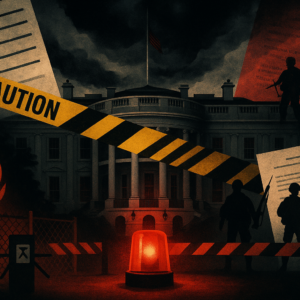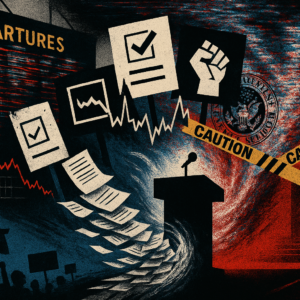
The political system does not usually break in one clean motion. It buckles in stages, under pressure from multiple directions at once. Right now, three separate storylines are fusing into one larger mood of institutional distrust: military draft panic, impeachment escalation, and the renewed Epstein orbit around Trump-world.
Each of these stories is combustible on its own. Together, they create something more dangerous, a public sense that the people in charge are reckless, compromised, and increasingly unable to control the consequences of their own decisions.
The draft story turns foreign policy into a household threat
The most emotionally potent trend is the automatic registration for the military draft. For years, most Americans experienced foreign policy as something distant, abstract, and heavily mediated through pundits, maps, and talking points. Draft registration changes that calculus instantly.
The moment war becomes legible as a possible claim on your son, your brother, or your future, the rhetoric stops sounding strategic and starts sounding predatory. This is why draft-related stories are moving so fast across Reddit and X. They collapse the distance between elite decision-making and ordinary family risk.
That shift matters politically. It transforms the Iran story from a debate about strength, deterrence, and credibility into a debate about sacrifice, hypocrisy, and whether the same class that talks casually about escalation would ever bear its cost. Historically, this is where war messaging starts to fray. Once the public senses a potential blood tax, slogans stop working.
There is a reason draft politics have haunted Washington since Selective Service became a symbol of state reach rather than patriotic obligation. In an era already defined by low trust, automatic registration lands less like civic administration and more like an alarm bell.
Impeachment is no longer fringe theater, it is becoming a governing frame
The second major trend is the transition of impeachment talk from performative outrage to organized political structure. The filing of H.Res. 1155, paired with wider institutional pressure and a growing chorus of elite actors demanding removal, suggests that impeachment is no longer just a media food fight. It is becoming a serious interpretive frame for everything else.
That matters because once impeachment becomes the lens, every new development stops being a standalone scandal and starts functioning as corroborating evidence in a larger case. The Iran escalation is no longer just a foreign policy gamble. It becomes evidence of recklessness. War powers fights are no longer procedural disputes. They become evidence of executive overreach. Administrative chaos is no longer mere incompetence. It becomes evidence of unfitness.
This is how political gravity shifts. The key question ceases to be whether each individual controversy is survivable. The real question becomes whether the controversies are beginning to reinforce each other into a durable story about regime instability.
That is what makes moments like blocked war powers votes, public elite defections, and institutional criticism so important. As impeachment moves from slogan to scaffolding, the center of debate moves with it. The public no longer asks only whether an action was bad. It starts asking whether the whole governing structure is rotten.
The Epstein angle keeps poisoning any attempt at narrative reset
The third trend is the one that refuses to die because it touches a deeper national suspicion: the belief that elite networks protect themselves through silence, delay, and controlled disclosure. The renewed focus on Melania, Ghislaine Maxwell, and the broader Epstein adjacency is powerful not merely because of the facts alleged, but because it reinforces the public feeling that there is always another hidden chamber behind the visible scandal.
Stories like Melania Trump denying any connection to Epstein do not calm the situation. They often intensify it. In a collapsed-trust environment, denial reads less like closure and more like confirmation that the subject has become dangerous enough to require direct response.
This is part of a broader information problem in American politics. We no longer live in a world where scandal arrives, peaks, and resolves. We live in a drip economy. Emails surface. Old photos reappear. New claims attach themselves to existing suspicions. Commentary ecosystems stitch the fragments together faster than institutions can meaningfully address them. The result is not clarity but permanent contamination.
That contamination is politically devastating because it prevents narrative reset. Every attempt to pivot back to policy, patriotism, or economic reassurance gets dragged back into the swamp of elite impunity. And when the public believes there are two justice systems, one for insiders and one for everyone else, it becomes nearly impossible to restore legitimacy through messaging alone.
For context on why elite scandal networks have such a long afterlife, it is worth revisiting broader reporting on Jeffrey Epstein and how unresolved institutional questions tend to keep metastasizing.
These trends are feeding each other
The most important takeaway is not that these are three big stories. It is that they are becoming one story in the public mind.
The draft panic tells people the state may demand sacrifice. The impeachment push tells them leadership may be lawless or unstable. The Epstein fallout tells them the elite class may also be morally protected from consequences. Put those together and the public receives a brutal message: the people at the top are dangerous, unaccountable, and willing to make everyone else pay the price.
That is a much more powerful narrative than any single headline. It also explains why these themes are traveling so well online. They are not disconnected. They rhyme. They collapse into one intuitive civic conclusion, that the institutions asking for trust have done very little to earn it.
This is the deeper trend worth watching. Not just outrage, and not just scandal, but convergence. When foreign policy fear, constitutional crisis, and elite-depravity narratives start moving together, the country does not merely become polarized. It becomes harder to govern.
And once that happens, every new story is no longer judged on its own merits. It is absorbed into the same accumulating verdict.